Curriculum5 min read

Why fractions break so many confident Year 5 students

Your child was fine at maths. Then fractions arrived. This is one of the most predictable wobbles in primary school, and there are good reasons for it.

Written by a practising Australian teacher·SubjectMate

Somewhere around Year 5, this happens in a lot of houses.

A kid who's been perfectly good at maths for years suddenly isn't. Homework takes twice as long. The confidence drops. You start wondering what changed.

Usually nothing about your child changed. Fractions arrived.

Fractions ask your child to unlearn everything

For 5 years, your child has been building rules about numbers that have worked every single time.

Bigger numbers are worth more. Multiplying makes things bigger. Dividing makes things smaller. Numbers are made of units you can count.

Fractions break all of it at once.

Suddenly 1/8 is smaller than 1/4, even though 8 is bigger than 4. Multiplying by 1/2 makes things smaller. Dividing by 1/2 makes things bigger. And the thing you're counting isn't a unit any more, it's a relationship between two numbers.

This isn't a small step up. It's the first time in your child's life that their maths instincts are actively wrong.

Researchers call the leftover habit whole number bias. It explains most of what you'll see on the page.

The mistakes that look careless and aren’t

When your child says 1/3 is smaller than 1/4, that's not a slip.

That's their entire maths education so far, working exactly as trained.

When they add 1/2 and 1/3 and write 2/5, they're doing something completely logical. Add the tops, add the bottoms, the way they've added everything else since Year 1. Nobody's ever told them there's a kind of number where that's illegal.

Telling them it's wrong does almost nothing. They need to see why. And that means the fraction has to become a thing, not a rule.

Why this year matters more than you’d think

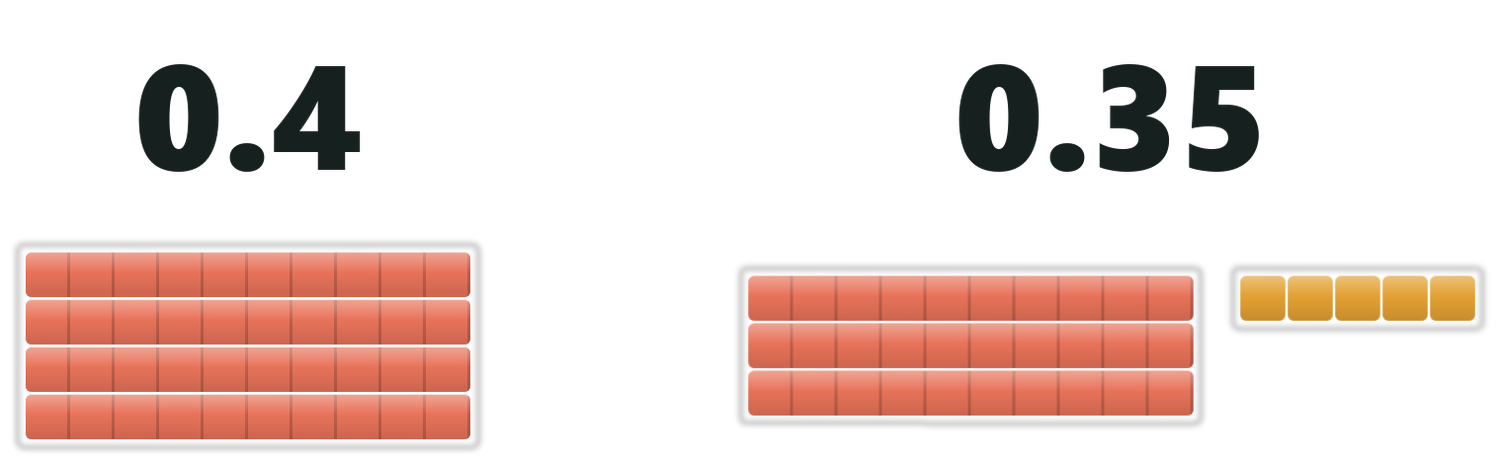
The Australian curriculum asks Year 5 students to compare fractions with related denominators, add and subtract them, and connect fractions with decimals and percentages.

That's a heavy year. And it lands exactly when the underlying idea is at its least intuitive.

Here's the part worth knowing. Siegler and colleagues (2012) tracked big national data sets in the US and UK. They found that primary students' knowledge of fractions and division uniquely predicted their algebra results and overall maths achievement in high school, 5 or 6 years later.

That held even after controlling for other maths knowledge, general intellectual ability, working memory, and family income and education.

Read that again. Of everything your child learns in primary maths, fractions and division are the two things that best predict where they land in Year 10. Not general cleverness. Not your bookshelf. Fractions.

What helps

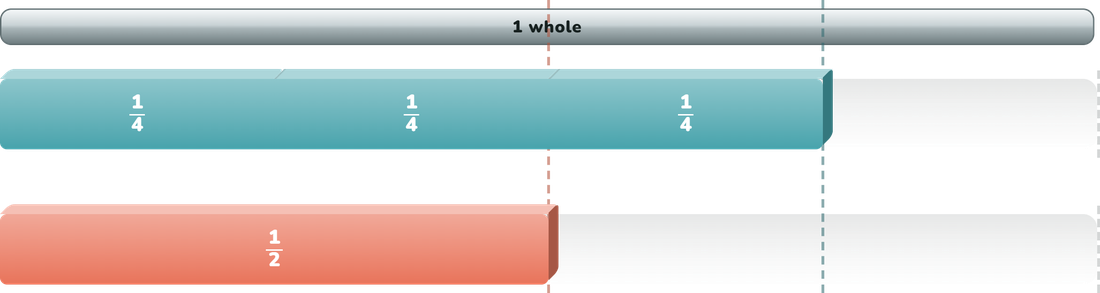
Make it physical before it's symbolic. Fold paper. Cut up a pizza. Use a measuring jug. A kid who has physically found that two quarters and one half take up the same space has something no worksheet can give them.

Live on the number line. A fraction is a number with a location, not two digits with a line between them. Where does 3/4 sit? What about 5/4? The number line quietly kills more misconceptions than anything else in primary maths.

Ask what the whole is. Half a bus is bigger than half a biscuit. Fractions mean nothing without their whole, and kids who ask that automatically make far fewer mistakes.

Never accept a right answer without a reason. "How did you know?" is the most useful thing you can say here. If the reason's sound, the answers keep being right. If it's a half remembered rule, they'll stop being right in about 3 weeks.

Don't rush to the shortcut. Cross multiplying and common denominators are useful, and they'll come. But if they arrive before your child knows what a fraction actually is, they're just one more thing to forget under pressure.

If it’s already gone wrong

The good news is that fractions are specific.

Unlike a vague sense of being bad at maths, a fractions gap can be found and closed. It takes patient work on the idea rather than more drilling on the procedure, and it's entirely fixable in Year 6, Year 7 or later.

The mistake is assuming it'll sort itself out. It rarely does, because the next topic assumes it, and so does the one after that.

This is exactly what SubjectMate was built for. It works through the problem with your child rather than handing over the answer, which is the only way a fraction stops being a rule and starts being a thing they understand. It's aligned to your state's curriculum, so it covers what their class is doing this term, and it's there at 8pm when the homework falls apart.

Year 5 Maths tutoring starts with a free trial, and you can stop any time.

Common questions

Why are fractions harder than other maths topics?
Because they contradict rules your child has relied on for years. Bigger denominators mean smaller pieces, multiplying can make numbers smaller, dividing can make them bigger. That leftover habit is called whole number bias and it causes most fraction errors.
What fractions does my child learn in Year 5?
The Australian curriculum expects Year 5 students to compare fractions with related denominators, add and subtract them, and connect fractions with decimals and percentages.

References

  1. Siegler, R. S., Duncan, G. J., Davis-Kean, P. E., Duckworth, K., Claessens, A., Engel, M., Susperreguy, M. I., and Chen, M. (2012). Early predictors of high school mathematics achievement. Psychological Science, 23(7), 691–697. https://doi.org/10.1177/0956797612440101
  2. Siegler, R. S., Thompson, C. A., and Schneider, M. (2011). An integrated theory of whole number and fractions development. Cognitive Psychology, 62(4), 273–296. https://doi.org/10.1016/j.cogpsych.2011.03.001
  3. Australian Curriculum, Assessment and Reporting Authority. Australian Curriculum Version 9: Mathematics, Year 5. https://v9.australiancurriculum.edu.au/

Support that guides rather than tells

SubjectMate asks your child what they know first, then guides them to the answer. Built by a teacher, available every school night.

See how it works →

More for parents

Why capable students dip in Year 75 min read Choosing senior subjects: what actually matters6 min read